Weather could give Russia an edge in massive winter Shahed attacks, expert says


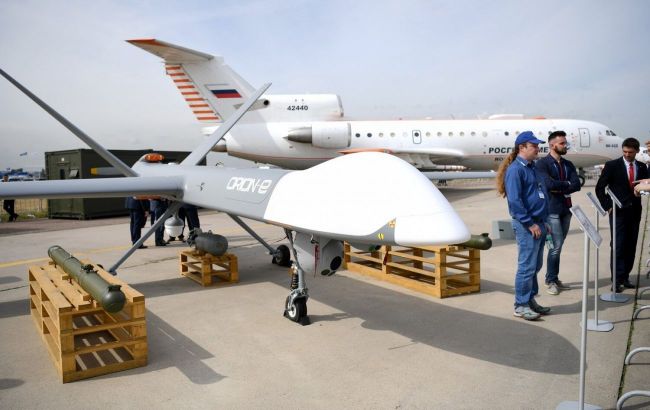 Photo: The Banderol carrier—the Orion drone (Russian media)
At the end of summer and the beginning of fall, Russia switched to attacks using jet-powered Shahed drones. However, weather conditions affect drone attacks and their interception, says Kyrylo Liukov, head of the unmanned technologies department at the Serhiy Prytula Charity Foundation.
Should we expect massive attacks in winter?
According to Liukov, Russia's transition from internal combustion engines to jet engines is directly linked to Ukraine's effective countermeasures.
But he thinks that in the fall or winter, due to poor weather conditions, massive raids by conventional Shaheds with internal combustion engines may be possible — in this way, Russia will try to overload Ukrainian air defenses.
"With jet drones, we are responding again. We are not ready for the problem and are forced to look for new solutions," the expert said.
Liukov also noted that weather conditions significantly affect the operation of countermeasures in general. Not all counter-drone systems are protected enough to operate in the rain, while strong winds limit the flight and tactical characteristics of interceptors.
Cold weather and frost, according to Liukov, seriously reduce the energy efficiency of interceptor drones. Also, first-generation interceptor drones are guided via an optical sensor, while capture and homing modules are far from being available on all of them.
How is Ukraine responding to jet-powered drones?
According to the expert, conventional multicopter interceptors are capable of catching up with jet-powered Shaheds only as an exception — the targets are flying at significantly higher speeds. The first option for solving the problem is to accelerate conventional interceptors to more than 400 km/h, but this greatly reduces their useful time in the air.
"Therefore, the only way here is maximum automation, as well as improving detection and targeting capabilities so that automation is appropriate at all," Liukov explained.
According to him, a number of jet-powered interceptors with sufficient speeds to destroy jet drones are already appearing in Ukraine, although scaling up production is complicated by their higher cost and the lower availability of jet engines compared with internal combustion or electric motors.
Liukov noted the effectiveness of MANPADS against jet drones due to their noticeable thermal signature, but pointed to a shortage of these systems, their cost, and the need for trained personnel.
Countering jet-powered Shaheds has remained one of the key challenges for Ukrainian air defenses in recent weeks. At the end of August, Tymofii Yurkov of Contra-Drone reported that jet drones traveling at speeds exceeding 400–450 km/h are becoming an increasingly difficult target for interceptor drones, as most interceptors simply cannot maintain such a flight speed.
At the beginning of September, it became known that during attacks on Kyiv, hundreds of jet-powered UAVs avoid a direct route to the capital and stay as close as possible to the border of a neighboring country for as long as possible. According to experts' observations, Russia uses this tactic to exhaust the air defense system and paralyze the city's vital activities with constant air raid alerts.