Volcanic eruptions can change Earth's climate: New risks the Northern Hemisphere revealed

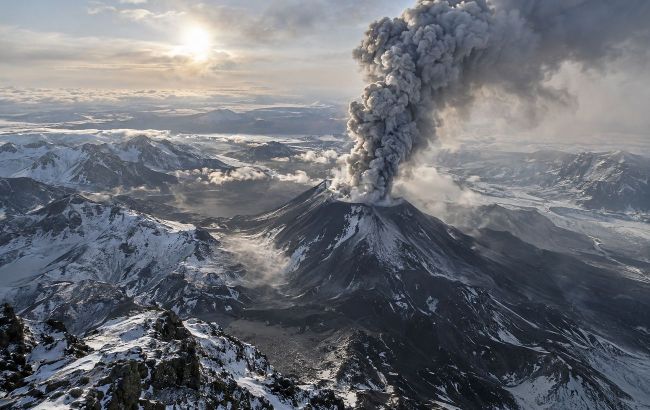 Illustrative photo (collage: RBC-Ukraine)
Volcanic eruptions can cool the Earth's surface for years. However, the extent of this effect may depend on geography, according to Geophysical Research Letters.
How volcanic eruptions cool Earth
According to scientists, volcanic eruptions can cool the Earth's surface for years by dispersing reflective aerosols into the stratosphere.
The idea is that during powerful eruptions, significant amounts of sulfur dioxide are released into the stratosphere.
There, this gas reacts with water vapor and oxygen, resulting in the formation of microscopic droplets of sulfuric acid.
These droplets form aerosols that scatter and reflect solar radiation into space.
As a result, less thermal energy reaches the planet's surface, which can cause a cooling effect lasting several months or even years.
Read also: Ukraine's secret active volcano: Where to find this natural wonder
Which theory about volcanoes scientists decided to test
It is believed that most volcanic eruptions that affect the climate occur in tropical regions.
For example, the 1815 eruption of Indonesia's Mount Tambora caused global climate disruptions—the year 1816 even went down in history as the Year Without a Summer.
However, some recent studies point to the extremely significant impact of extratropical eruptions on temperatures in the extratropical latitudes of the Northern Hemisphere.
Based on this, Dr. Zachary McGraw of Columbia University and his colleagues decided to investigate whether the intensity of cooling truly depends on the volcano’s geographic location.
What scientists discovered as a result of their research
Previous studies had suggested that eruptions in mid-latitudes (between 30° and 70°) could cause significantly greater cooling in the Northern Hemisphere than tropical eruptions of similar intensity.
To test this hypothesis, the researchers used a NASA climate model to simulate eruptions in the tropics and mid-latitudes, taking into account different volumes of sulfur dioxide emissions as well as the season in which such an event occurred.
The results did not confirm the initial assumptions.
Specifically, under a favorable scenario, an eruption in mid-latitudes amplified the cooling effect only twofold (rather than 7.5-fold, as previously claimed).
"Using a large ensemble of simulations spanning the eruption size range from 5 to 40 Tg of stratospheric sulfur, we find that the extratropical-to-tropical cooling ratio is consistently within a factor of two, indicating no enhancement beyond the effect of aerosols being confined to a single hemisphere," the researchers state.
They note that this situation may be explained by the specific patterns of aerosol dispersion:
- After eruptions in mid-latitudes, aerosols predominantly remain in the Northern Hemisphere
- After tropical volcanic eruptions, they can spread to both hemispheres, distributing the cooling effect more evenly.
According to the researchers, this is the only mechanism identified so far that can explain the stronger impact of extratropical eruptions.
What else scientists analyzed as part of the study
To verify the results of their modeling, the researchers also decided to analyze:
- Historical climate data
- Tree rings (whose width varies depending on temperature and precipitation).
For example, the scientists took into account data on historical eruptions in Iceland (1783), in the mid-latitudes (around 536), and in Alaska (43 B.C.).
In addition, the experts simulated 100,000 hypothetical extratropical eruptions (to compare their effects with climate data on tropical eruptions that occurred after 750 CE).
The results showed that cooling in the Northern Hemisphere most often coincides in time with tropical eruptions.
The researchers note that the difference may be explained by several factors:
- Duration of aerosol presence in the atmosphere (after extratropical eruptions, typically persist for up to nine months, whereas after tropical eruptions, they can remain for up to three years)
- Emission of sulfur-containing gases at lower altitudes
- More intense washing out of aerosols by rain and snow in colder and wetter regions
- Transport of particles from mid-latitudes to the poles.
How results of such studies can be useful
Overall, according to the scientists, the results of this study will help:
- More accurately assess the impact of volcanic activity on the climate
- Distinguish between short-term natural cooling events and long-term changes (caused, in particular, by anthropogenic greenhouse gas emissions).
In addition, this is important for forecasting risks in agriculture and assessing global food security.
After all, a sudden drop in temperature can lead to crop failures, food shortages, and intensified competition for resources (creating additional risks for society).