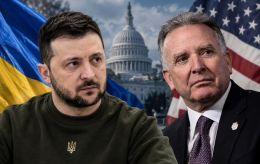
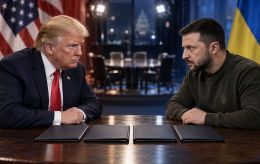
Trump vs. Zelenskyy: 4 blows the US has dealt Ukraine amid elections and peace talks


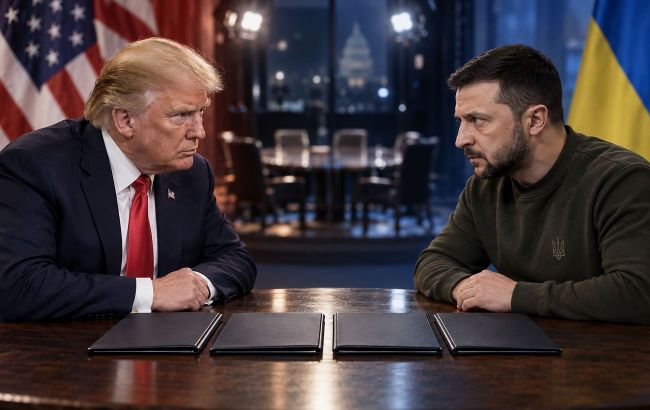 Photo: Donald Trump and Volodymyr Zelenskyy (RBC-Ukraine collage)
The closer the US elections get, the sharper US President Donald Trump's statements against Ukrainian leader Volodymyr Zelenskyy become. But the negotiating track continues, and a meeting between Ukrainian and US teams is scheduled for today.
Read what is happening now and how Trump explains his attacks on Zelenskyy.
Trump's controversial decisions
The US president has been "attacking" Ukraine and Zelenskyy for several weeks. He has resorted to his now-familiar statements that Zelenskyy does not want to reach a deal and that Ukraine needs a new leader. Yesterday, for example, he repeated these claims, saying that it is time for someone else to lead negotiations on behalf of Ukraine.
Trump has not limited himself to words. Over the past few weeks, Ukraine has received several powerful "blows" from the US.
The first blow. A little over a week ago, the American leader announced a diesel deal with Putin. Trump reached an agreement with Putin on supplies of Russian fuel to the US. In this way, Trump is trying to solve the problem of high fuel prices. He blames Ukraine for the problem, claiming that US diesel prices have risen because of Ukrainian strikes on Russian oil refineries.
Interestingly, Trump announced the diesel deal on social media just as Ukrainian negotiators arrived in Miami for talks.
The second blow. Just a few days after the diesel deal, Trump suddenly wrote on social media that Ukraine and Russia had agreed to an "energy truce." Ukraine, incidentally, learned about it from the news, while Russia did not comment on it at all for several days. As a result, Ukraine refrained from striking enemy oil refineries and energy infrastructure for three days. The Russians, meanwhile, said that the idea was being discussed but that there were no specifics. A few days later, they openly declared that they would continue striking Ukraine's energy infrastructure.
The third blow from the US against Ukraine was a pause in intelligence sharing, which the Americans deny. They help Ukraine's Air Force detect incoming ballistic missile launches. Both the Air Force and Zelenskyy have repeatedly stated that they did not receive information from partners during ballistic missile attacks. This does not mean a complete absence of information, but rather selective data: information is available for one attack but not for another.
The fourth blow. Another surprise for Ukraine was the restriction of Starlink's operations. This became critical not only for the front line but also for the rear. Since late summer, Russia has actively begun attacking Ukraine with jet-powered Shahed drones, first targeting Kyiv and later the western regions. This posed a new challenge for the Air Force. Ukraine began developing interceptor drones, which need Starlink to operate effectively. But its speed was suddenly restricted. Once again, the Americans deny everything.
How Zelenskyy is responding
The Ukrainian president has responded quite actively to Trump's attacks, including through interviews with Western media. Zelenskyy believes relations with Washington could improve after the US midterm elections.
"During elections, politics is very aggressive. I think this is painful right now, but after the elections, life will go on, and I believe things will become calmer," he said in one of his recent interviews.
In response to Trump's calls for elections in Ukraine, Zelenskyy said that 60 days of calm would be needed to allow the country to prepare for the vote. He also confirmed that he would run if elections were held during the war. The Russians immediately rejected such a proposal, saying they would agree not to strike Ukraine only on election day.
Zelenskyy also reacted sharply to the diesel deal. The president believes this is only the beginning and that sanctions against Russia will continue to be eased. In Zelenskyy's view, gas deals, decisions concerning the banking system, certain sanctioned individuals, and the chemical industry will follow.
As for the "energy truce," Zelenskyy learned about it from the news. Ukraine has repeatedly expressed its willingness to agree to any truce. Zelenskyy rejected Trump's accusations regarding diesel prices in the US. He emphasized that fuel prices in the US are affected by the war in Iran, not strikes on oil refineries.
Nevertheless, Ukraine was also willing to stop the strikes in exchange for Patriot missiles. But no such deal was reached. Instead, Ukraine was threatened with a pause in intelligence sharing if the strikes on oil refineries continued.
Zelenskyy recently reported delays in deliveries of missiles that have already been paid for. According to him, the US supplies Ukraine with only 12 Patriot missiles per month.
Zelenskyy considers the slowdown of Starlink a planned operation. The maximum speed currently allowed is 161 km/h, after which Starlink shuts down, and the drone is lost. Ukraine currently cannot use Starlink within its territory to shoot down jet-powered Shahed drones.
"To find out whether these are genuine technical problems at SpaceX or some kind of agreement to restrict us, we sent a couple of vehicles to EU countries with Starlink, and they drove at 180 km/h, and Starlink worked," Zelenskyy explained.
Overall, commenting on the American side's recent actions, Zelenskyy said that Ukraine was being pressured to surrender.
"I believe that steps have been taken to convince Ukraine to capitulate. I am not saying that this is the goal of our partners. I do not want to think that our American partners believe the war against Russia could have been ended earlier at Ukraine's expense. But that is how it looks," he said.
The negotiating track is continuing for now. Today, a meeting between Zelenskyy and Trump's representatives is scheduled to take place in Oslo. The US is also working on a trilateral meeting that could take place in the Middle East, on the sidelines of the G20 summit in the US, or in one of the European countries. "I know that Europeans are beginning to contact about this," Zelenskyy said.
In Zelenskyy's view, Europe needs to have its own track for negotiations with Russia. Several countries are also promoting their own ideas for a truce, including Türkiye, Egypt, and India.