Serbia faces possible EU blacklist over 'Bosnian butcher' legacy

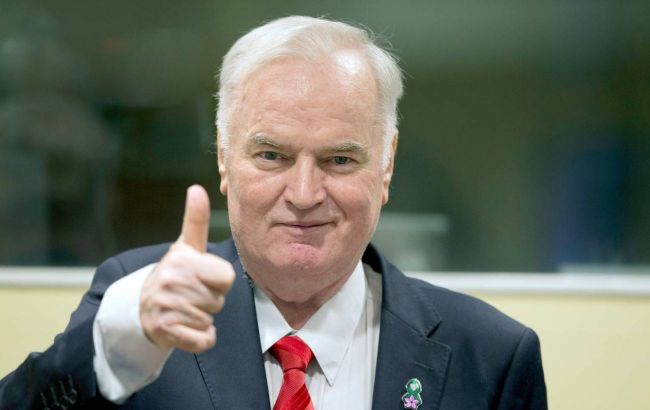 Photo: Ratko Mladić at trial in The Hague (Getty Images)
Croatia has opposed the planned burial of Ratko Mladić with full state honors. The former commander of the Bosnian Serb army died in a UN prison in The Hague, where he was serving a life sentence following a conviction by an international court, according to broadcaster HRT.
Croatian Prime Minister Andrej Plenković stated that such a move could negatively affect Serbia's European prospects. Zagreb also points out that Mladić is linked not only to the crimes for which he was convicted by the international court in The Hague.
"This would be the same as them closing the door to the European Union themselves," Plenković said.
According to the Croatian prime minister, this concerns a person who was involved in the gravest crimes during the wars on the territory of the former Yugoslavia.
What Mladić is accused of in Croatia
The Hague Tribunal did not convict Mladić for crimes committed specifically in Croatia. However, in July 1992, a court in the Croatian city of Šibenik sentenced Mladić in absentia to 20 years in prison for war crimes against the civilian population. He was found guilty, among other things, of ordering an attack on the village of Kijevo on August 26, 1991, while serving as chief of staff of the 9th Knin Corps.
According to the Croatian prosecutor's office, approximately 1,600 artillery shells were fired at the settlement, and cluster munitions were also used. The village was almost completely destroyed.
The same case involved strikes on Sinj, Vrlika, Mačkovac, Potravlje, Šatrić, and Dabar, as well as attacks on civilian facilities in Šibenik.
The Croatian prosecutor's office also investigated Mladić's role in the shelling of Zadar and other settlements in Dalmatia. In particular, the prosecutor's office noted that during the shelling on December 25 and 31, 1991, three civilians were killed and five others were seriously injured, including a ten-month-old child.
Attempt to destroy the Peruča dam
One of the most serious accusations was the planning of the destruction of the Peruča dam on the Cetina River. According to the Croatian prosecutor's office, Mladić and other commanders planned to destroy the dam to flood settlements downstream - Sinj, Trilj, and Omiš, where more than 50,000 people lived.
Approximately 30 tons of explosives were placed in the structure. The explosion caused extensive damage to the facility, but it was not possible to completely destroy the dam.
Killings of civilians in Škabrnja
Plenković specifically mentioned Škabrnja in his statement. On November 18, 1991, the day Vukovar fell, Serb forces captured Škabrnja. Civilians and defenders of the settlements were killed in the village and the neighboring village of Nadin.
The Croatian prosecutor's office also initiated proceedings regarding rocket attacks on Požega and areas of Slavonia in 1995. According to the investigation, this involved the use of rockets with cluster munitions, resulting in the death of one civilian and injuries to three others.
What the Hague Tribunal convicted Mladić of
Mladić, nicknamed the "Butcher of Bosnia," was sentenced to life imprisonment in 2017. The court found him guilty of genocide, crimes against humanity, and violations of the laws or customs of war committed during the war in Bosnia and Herzegovina.
Among the crimes established by the court were the genocide in Srebrenica, persecution, extermination, murder, deportation, and forced displacement of Bosnian Muslims, a campaign of terror against the civilian population of Sarajevo, and the taking of UN hostages.
Attitude toward Mladić in Serbia
Many Serbs with far-right views consider him a national hero. Politicians also believe that the general should be buried with military honors, while the government led by Vučić has shown a restrained position.
At the same time, the progressive, liberal, and human rights segments of Serbian society recognize Ratko Mladić as a war criminal and condemn crimes against humanity.
Context of the Croatian prime minister's statement
The Serbian Minister of Justice announced the burial of Ratko Mladić with state honors. Serbia declared its readiness to immediately retrieve his body from the Netherlands.
Meanwhile, Russia expressed condolences to the family of the deceased criminal. The Kremlin does not recognize the tribunal's verdict in The Hague.