Russia's Duma elections begin with fraud, coercion, and communication blackouts

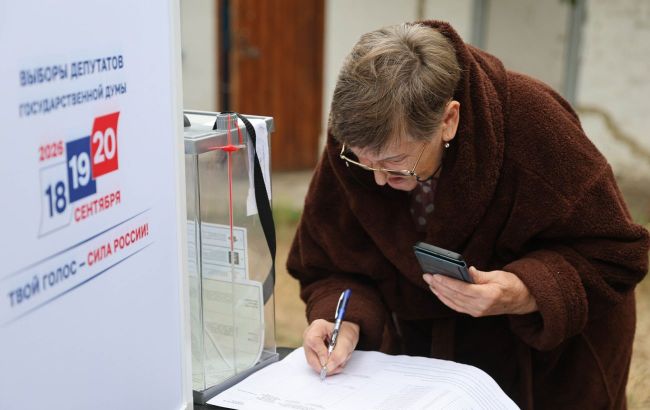 Photo: the most critical situation in the regions bordering Ukraine (Getty Images)
In Russia, elections to the State Duma began today, September 18, and will last for three days. However, right from the start, there have been reports of pressure on observers, coercion of public sector employees, and mass falsifications, according to Russian media outlets and Telegram channels such as Vazhnyye Istorii, ASTRA, Verstka, and others.
Just before the start of the elections, the head of Russia's Central Election Commission (CEC), Ella Pamfilova, warned that there might be disruptions in mobile communications and the internet during the voting period. However, she claimed this would not interfere with the electoral process.
"There may be some, let's say, unintentional disruptions in mobile communications and data transmission. For us, this is not a reason to cancel the voting," she stated.
But it is important to immediately add that numerous violations and even intimidation of independent observers and opposition representatives began even earlier.
According to Russian state media, in the Altai Krai, election commissions are falsifying lists for home voting. In particular, Russians are being added to the lists without their consent, although they did not submit any corresponding applications. To verify this, activists called the addresses on the list, and residents confirmed that they had not sent any requests and were not expecting visits from commission members.
Residents of this region are also being forcibly registered for online voting. According to the latest data, more than 250,000 applications for such voting have already been submitted by residents of Altai Krai (this is almost 15% of the total number of voters).
Furthermore, authorities are forcing public sector employees to report individually on who voted for the party of Russian leader Vladimir Putin, "United Russia." Such instructions are in place at least in Altai Krai and several other regions - Novosibirsk, Sverdlovsk, Nizhny Novgorod, and Samara regions.
Pressure on the opposition and observers
Russian media report that persecution of representatives of the anti-war party "Yabloko" was recorded in Kazan. In particular, candidate Sofia Fedorova stated that party members were attempted to be evicted from their own office.
Specifically, on September 16, immediately after a meeting with supporters, the electricity was cut off at the Yabloko office, and on the same day, the landlord demanded that the party vacate the premises and terminate the contracts. However, the oppositionists managed to restore power and retain the office.
This was not the only incident. For example, in the Sverdlovsk region, five Yabloko candidates were removed from the elections, while in the Tambov region, security forces are calling observers from this political force and demanding meetings with them. Moreover, police officers admit to having a large list of observers on hand.
But these problems affect other parties as well. Thus, in the Voronezh region, about 400 observers from the Communist Party of the Russian Federation (CPRF) were not allowed into polling stations. The reason cited was deficiencies in documents.
Where the situation is critical
It is reported that the most critical situation has occurred in Russian regions bordering Ukraine. There, the Central Election Commission (CEC) allowed early voting to begin 12 days before the single voting day.
Media outlets report that in the Rostov region, Yabloko observer Boris Miklyukov was taken away by masked individuals. Eyewitnesses say that three people arrived for him, placed him in a non-official vehicle, and took him to Police Department No. 8 in Rostov. Currently, there is no contact with him.
In turn, in Belgorod, on the first day of early voting, ballot stuffing began at polling stations, and during home voting, members of election commissions are voting on behalf of people.
Additionally, one of the Telegram channels noted that in photos from polling stations, there are more ballots in portable boxes for home voting than in stationary boxes located at the polling stations.