Putin's battlefield claims are so unrealistic they resemble hallucinations, analysts say

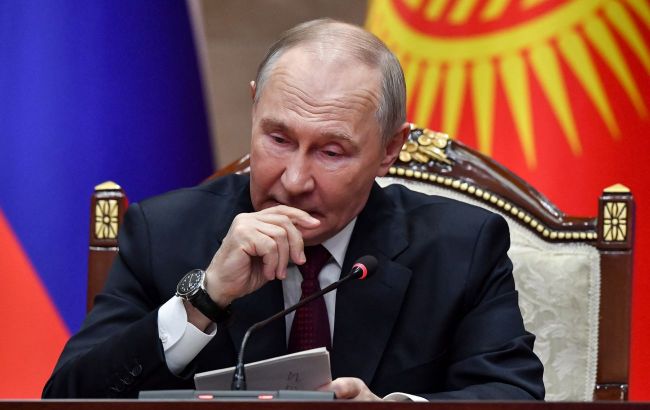 Photo: Vladimir Putin (Getty Images)
Russian leader Vladimir Putin claimed that in September, Russian forces seized more than 1,000 square kilometers of Ukrainian territory, but the actual data show otherwise, according to the Institute for the Study of War (ISW).
Putin claimed that in September, the Russian army seized 1,301 square kilometers of Ukrainian territory. According to his statement, this is 2.5 times more than the territorial gains Russia reported in previous months.
However, an analysis of the situation on the front that ISW conducted shows a completely different dynamic.
"Putin claimed Russian frontline gains in September 2026 so far from reality as to resemble hallucinations," the report says.
According to the institute, in September, Russian forces suffered net territorial losses of 80.81 square kilometers.
In other words, this is not about the seizure of more than 1,300 square kilometers, as Putin claimed, but the opposite trend — at the end of the month, the Russian army lost more territory than it gained.
Analysts also separately took into account cases when Russian troops advanced in certain areas but failed to establish control over them. Even with this approach, the result remains the opposite of the Kremlin's claims.
Taking such incursions into account, the net territorial losses of Russian forces in September amounted to 175.18 square kilometers, ISW notes.
What is the Kremlin's goal?
The institute believes that Putin's statements create a distorted picture of the fighting. According to analysts, they create the impression of a supposedly large-scale Russian offensive covering the entire front.
ISW called such claims part of the Kremlin's cognitive warfare, aimed at portraying the Russian offensive as significantly larger than it actually is.
Analysts emphasized that they cannot assess whether Putin knows that the figures he cited do not correspond to the real situation. ISW suggests that he may simply be receiving distorted data about the course of the fighting.
According to analysts, this may be related to a culture of concealing failures and providing leadership with convenient information that, in their assessment, is deeply rooted in the Russian military command structure.
Russia continues to increase spending on its army despite the growing burden on the economy and the state budget.
In 2027, Russia plans to spend 17.1 trillion rubles on military needs — more than 40% more than planned for 2026.
Compared with the pre-war period, Russia's military spending has increased by nearly 380%. In 2028, Moscow plans to spend 16.6 trillion rubles, and in 2029 — 16.3 trillion rubles.