Putin orders 'General Armageddon' to destroy Kyiv’s bridges, media says

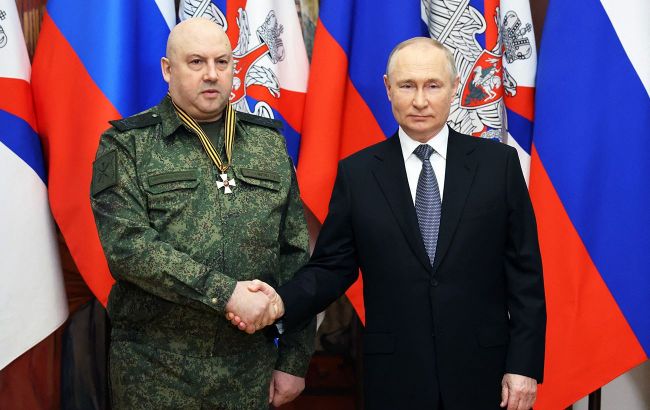 Photo: Russian General Sergey Surovikin and dictator Vladimir Putin (Getty Images)
In winter, Russian president Vladimir Putin may change his tactics in the war and target Kyiv’s bridges. General Sergey Surovikin, nicknamed “Armageddon,” who destroyed the Syrian city, has already been brought in for this purpose, reports The Telegraph.
The author writes that the Kremlin chief is once again resorting to a tactic he turns to when his army suffers setbacks on the battlefield. He intimidates civilians and destroys cities.
According to him, General Sergey Surovikin, nicknamed “General Armageddon,” has been brought in for Kyiv. He was the one who leveled Syria’s Aleppo to the ground, killing thousands of civilians in the process.
In the author’s view, Russia’s offensive in the Donbas has been facing serious difficulties for several months. Ukrainian forces are applying pressure around Pokrovsk and Lyman, while Russian losses remain enormous.
Ukrainian President Volodymyr Zelenskyy said that more than 10,000 Russian troops were killed in one week. Russia is paying an extremely high price for very limited territorial gains.
It is becoming harder for Russia to recruit enough contract volunteers to replace its losses. A new large-scale mobilization, which could affect hundreds of thousands of Russians, would be politically explosive, and the Kremlin understands this.
Therefore, the author believes, the Russian dictator needs a dramatic change in the situation on the battlefield before he is forced to make a decision that threatens his rule. The answer is becoming increasingly obvious: if Russia cannot defeat the Ukrainian army, it will try to break the Ukrainian people this winter.
The author recalls that this is not a new tactic. Russia supported Bashar al-Assad’s brutal campaign in Syria, where he saw firsthand what happens when hospitals, schools and residential areas become targets.
According to the author, the calculation is simple: kill, injure and intimidate civilians so that they themselves demand that the authorities end the war. It did not work in Syria, and, the author writes, it is unlikely to work in Ukraine either.
Kyiv’s bridges and the shortage of air defense missiles
The Telegraph’s analysis, based on ACLED data, shows that the share of drone and missile strikes on Kyiv among all strikes across Ukraine is increasing. The data runs through August 31, 2026.
The author identifies seven bridges across the Dnipro as obvious targets. Kyiv is a major hub for road and rail routes, so if the city is cut in half, it would paralyze the entire north of Ukraine.
For comparison, he suggests imagining that all the bridges in London, including those on the M25 ring road, were destroyed. The consequences would be felt throughout southeast England.
“This is not the behaviour of a man preparing to end his war. It is the behaviour of a dictator preparing his population for a longer one,” the author writes.
He sees the danger in the fact that Ukraine is running short of air defense ammunition. There is a particular shortage of powerful interceptor missiles, such as American-made Patriots.
Moscow, he says, knows this. Therefore, it is increasingly targeting not only military facilities but also infrastructure on which the functioning of Kyiv and other cities depends.
Russia is counting on exhaustion. It is significantly larger than Ukraine in terms of population and has gradually shifted its economy onto a war footing.
The Kremlin chief is willing to sacrifice soldiers. He believes Russia can endure losses longer than Ukraine can endure strikes, and longer than Western governments can sustain their support for Ukraine.
“The question is not simply whether Ukraine can hold Pokrovsk or Lyman. It is whether Britain and Europe have the political stamina to ensure that Ukraine is still standing next year, and the year after that,” the author emphasizes.
RBC-Ukraine previously reported that transport planning expert Dmytro Bespalov explained what solutions could help Kyiv withstand strikes on its bridges. According to him, no single idea will work on its own, and pontoons are only a last resort, so he places his main hopes on air defense and electronic warfare.
Bespalov also explained whether Kyiv’s bridges would withstand Russian strikes. In his view, the Russians are not seeking to completely destroy the bridges, but rather to paralyze movement around the city and frighten people.