Pi and golden ratio: Cosmic code discovered in Great Pyramid of Khufu

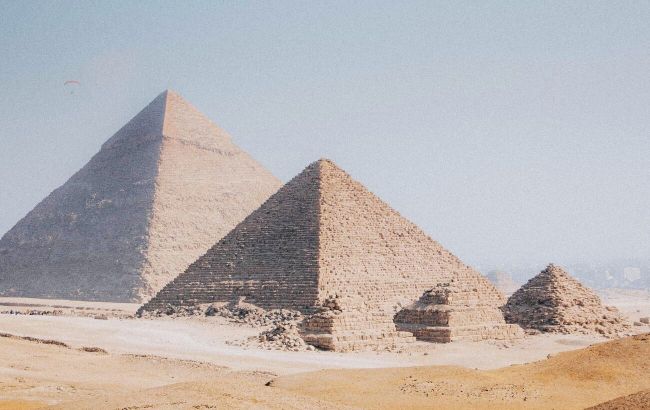 Number pi and golden ratio discovered in proportions of the Great Pyramid (photo: Pexels)
The Great Pyramid of Giza may hide a mathematical code within its very proportions. Independent researcher Sephy Levy claims that its height, base, and angles of inclination contain encrypted astronomical knowledge, according to the Daily Mail.
Connection with astronomy, mathematics, and randomness simulation
According to Levy's calculations, dividing the key parameters of the pyramid using ancient Egyptian scribes' methods yields results that coincide with important cosmic cycles.
In particular, one calculation gives the number 27.5, which corresponds to the lunar perigee (27.55 days), and another gives 70, which coincides with the 70-day period between the appearance of the star Sirius and the traditional longer mummification period.
Additionally, the calculations revealed ratios reminiscent of the value of pi, the golden ratio, and the orbital cycles of Saturn, Jupiter, Venus, and Mars.
To verify the probability of random coincidence, Levy conducted a computer simulation of 100,000 hypothetical pyramids from the Old Kingdom era with varying base sizes and angles of inclination.
Interestingly, only 2.4% of the sample (2,419 models) showed a similar or greater number of astronomical correspondences.
Connection with the Eye of the Sahara and scientific skepticism
In addition to the numerical code, Levy has put forward a radical theory regarding the spiritual and historical purpose of the monument.
He suggests that the Great Pyramid embodies the mythical primordial Benben mound, which, according to the creation myth, rose from the primordial chaotic ocean.
The researcher believes that this myth is based on a real geological object—the Eye of the Sahara (Richat Structure) in Mauritania, which thousands of years ago may have been surrounded by water.
According to his hypothesis, the ancestors of the Egyptians migrated eastward due to the desertification of the region and subsequently recreated the memory of their ancient homeland in the architecture of Giza.
However, academic Egyptology views such conclusions skeptically: Levy's work has not undergone independent peer review, and classical science continues to consider the pyramid a tomb for Pharaoh Khufu, built approximately 4,500 years ago.