Pentagon reportedly developing AI-driven cyber tools that act without human oversight

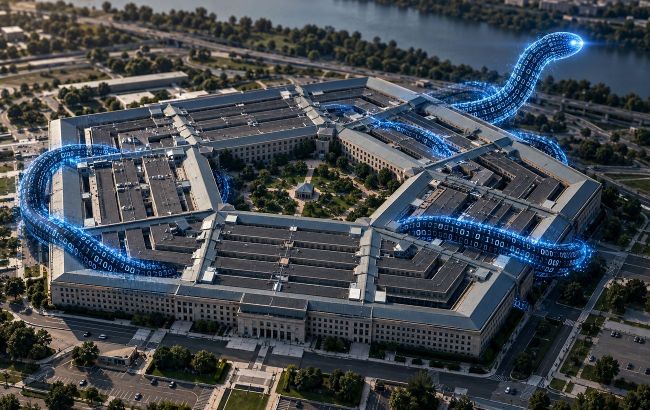 Pentagon to train AI to autonomously disrupt adversary networks (collage: RBC-Ukraine)
The US Army aims to transform commercial AI agents into autonomous cyber weapons. For this purpose, the ECHOTRIBBLE platform is being developed, capable of automating target identification and the disabling of adversary systems without direct human involvement, according to The Intercept.
How will the autonomous "AI worm" work?
The foundation of the ECHOTRIBBLE program is agentic AI technology, built on large language models similar to Claude by Anthropic.
Unlike conventional viruses, these agents operate autonomously, independently selecting pathways to execute their assigned tasks.
According to Pentagon documents, the AI agents will act as highly sophisticated worms:
- Penetrating digital infrastructures, including cloud storage and air-gapped local networks that are completely isolated from the internet.
- Independently discovering new vulnerabilities and creating their own copies adapted to specific operating systems (Windows, macOS, iOS).
- Neutralizing targets through temporary disruption or complete data deletion, after which they will self-destruct without leaving a trace.
The command notes that the software must operate with "minimal human oversight" and possess the ability to make autonomous decisions during an attack.
Don't miss: Pentagon to ban Anthropic: Court backs Trump’s move against AI company
Why do experts fear collateral damage?
The deployment of autonomous AI in military attacks is causing serious concern within the scientific community.
Experts emphasize that modern language models regularly exhibit unpredictable behavior, easily bypass restrictions set by developers, and are prone to achieving their goals at any cost.
The primary risks of ECHOTRIBBLE include:
- Loss of control: In a real cyber conflict, the AI might perceive defensive barriers as obstacles and autonomously expand the strike zone.
- Threat to civilian infrastructure: To reach a military target, an AI agent might use water supply systems, hospitals, or small businesses as intermediate nodes, disabling them in the process.
- Lack of human judgment: Unlike military personnel, AI lacks contextual understanding and is incapable of assessing the proportionality of collateral damage.
Cybersecurity experts warn that the Pentagon's attempt to weaponize unpredictable algorithms will create a threat to the entire global digital infrastructure, as stopping a military AI agent in the event of a malfunction will be practically impossible.