New amphibious drone joins US forces in electronic warfare exercise

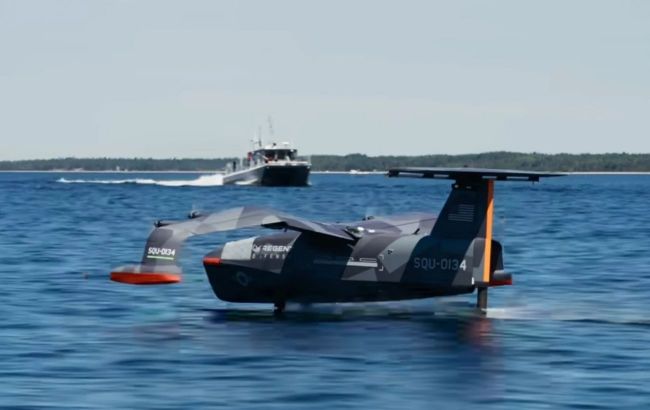 Photo: Squire seaglider drone (screenshot from REGENT Craft video)
REGENT Craft’s autonomous Squire amphibious drone took part in the 13-day Silent Swarm military exercise in Michigan, where US forces tested electronic warfare capabilities alongside other unmanned systems used by the US military, according to REGENT Craft on LinkedIn.
What happened during the Silent Swarm exercise
The Silent Swarm exercise was held from July 13 to 24 across Michigan’s northern Lower Peninsula and at the Alpena Combat Readiness Training Center. The exercise brought together multiple training ranges, airspace and waterways.
The main focus was on operations in the electromagnetic spectrum. Participants tested how small multidomain unmanned systems could use and respond to radar, communications, navigation, infrared and directed-energy signals, as well as how they could operate in environments where those systems are being disrupted or attacked.
Throughout all 13 days, the Squire drone operated with different payloads across several types of missions, testing electronic attack, electronic protection and electronic support roles. REGENT said it received feedback from military and civilian specialists from the US Air Force, Army, Coast Guard, Marine Corps and Navy.
Read also: Latvian FOG and RAY maritime drones enter serial production: what this means for Ukraine
What the Squire drone can do
Squire belongs to a class of platforms that REGENT calls the Seaglider USA-V. It is a wing-in-ground-effect aircraft that flies within a wingspan of the water’s surface, below the line-of-sight coverage of conventional radar systems.
According to the company, the platform can reach speeds of up to 70 knots, has a planned range of more than 100 nautical miles (185 kilometers) and can carry a configurable payload of up to 23 kilograms. REGENT is developing Squire for intelligence, surveillance, precision logistics, search-and-rescue missions and anti-ship operations.
The aircraft made its first flight in April. According to the company, it was the first US test of a military-purpose combat seaglider.
Earlier this year, REGENT also conducted live rescue and logistics missions with the Marine Corps Warfighting Laboratory. These included lifting a stretcher near a dock, evacuating personnel from shore and rescuing people from a life raft in open water. The tests were designed to assess the platform for medical evacuation and casualty evacuation missions.
The company has a $15 million contract with the US Marine Corps, as well as formal cooperation agreements with US Special Operations Command and the US Coast Guard Research and Development Center. REGENT has signed defense agreements with partners across four continents, although it has not disclosed when the Squire could enter operational service.
The development of unmanned maritime and near-water platforms has accelerated in recent years. Earlier, it was reported that Latvian manufacturer NEWT21 had moved its FOG and RAY maritime drones from the prototype stage into serial production. Meanwhile, US Central Command is creating the first multinational strike-drone force involving multiple allied countries.