Man convicted in Italy after building fake ancient theater to scam tourists

 Fake amphitheater (Photo: facebook.com/AnfiteatroMarittimoBerico)
A man in Italy spent years passing off a structure he built himself as an ancient Roman theater and even managed to get it listed in a regional tourist guide. After nearly a decade of legal proceedings, he has now been sentenced to prison, according to EL PAÍS.
He passed off a newly built structure as a historical monument
For about 20 years, 69-year-old Franco Malosso, who also called himself "von Rosenfranz," convinced visitors in the northeastern Italian city of Vicenza that he had discovered a unique archaeological site known as the Berico Maritime Amphitheatre.
He claimed the structure had been uncovered after a landslide in 2005 and charged tourists €40 for admission.
Malosso told visitors it was one of the oldest and largest amphitheaters in the world, dating back to 393 AD. He also claimed that Julius Caesar, Cleopatra, and even Juliet Capulet, the fictional heroine of Romeo and Juliet, had once visited the site.
How the truth came out
The deception unraveled in 2016 after local authorities filed a complaint. Archaeologists and Italy's military police investigated the site, eventually proving it was a complete fabrication and that no construction permits had ever been issued.
To make the attraction look ancient, Malosso built a semicircular complex in the Arcugnano Hills using modern materials, including artificially aged stone blocks, cement columns, plaster sculptures, and even an ornamental pond.
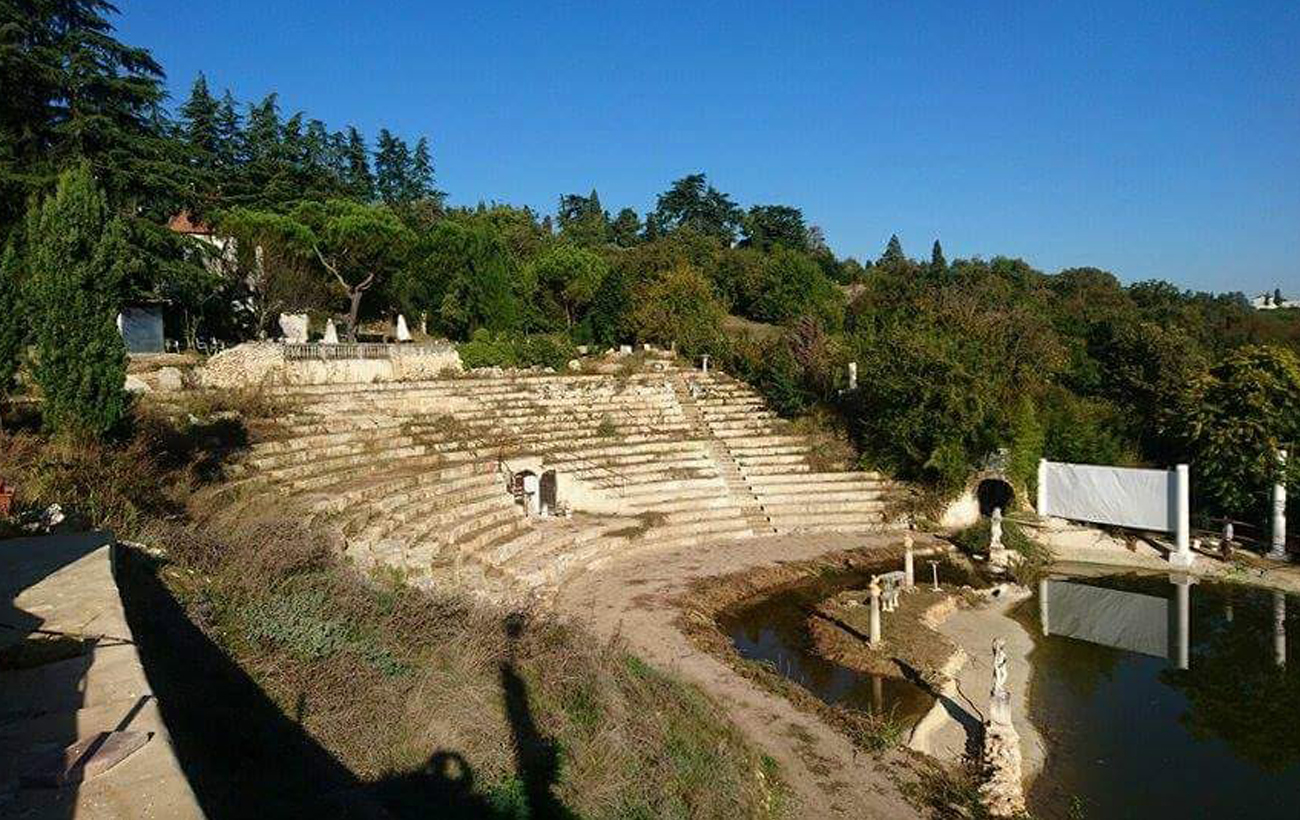 What the fake ancient theater looks like (Photo: facebook.com/AnfiteatroMarittimoBerico)
How the case ended
The legal battle lasted nearly 10 years.
Back in 2019, a court found Malosso guilty of illegal construction, forging works of art, and erecting structures without the required permits.
He was sentenced to two years and four months in prison, fined €3,000, and ordered to demolish the illegally built complex and restore the hillside to its original condition.
However, his lawyers spent years trying to overturn the ruling by filing multiple appeals. The case was finally brought to a close in July 2026, when the court rejected his final request to replace the prison sentence with community service.