France seeks joint rules with Germany for strikes on Russia amid nuclear war fears — FT

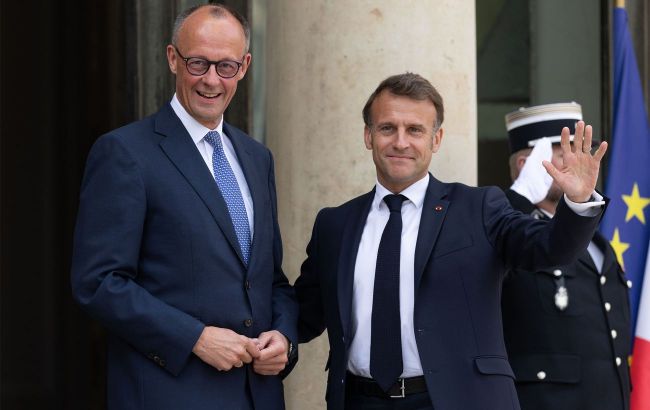 Photo: French President Emmanuel Macron and German Chancellor Friedrich Merz (Getty Images)
France wants to coordinate with Germany on the rules for the use of long-range missiles. Officials in Paris fear that a mistake could provoke a nuclear response from Russia, according to the Financial Times.
According to six sources familiar with the negotiations, France is holding consultations with German officials. Paris seeks to align Berlin's approach to the use of weapons for so-called deep precision strikes (DPS) with France's nuclear strategy.
One French official warns that even a strike with conventional weapons against a Russian target could trigger a nuclear response. According to him, if Moscow misinterprets the signal, the situation could quickly escalate to the level of nuclear war, and the parties might not realize the danger in time.
Why France concerned about Germany's plans
France's concerns stem from the fact that Germany and many other European countries are actively expanding their arsenals of long-range weapons. The United Kingdom, Poland, and the countries of Northern Europe and the Baltic states have joined this effort. The goal is to strengthen Europe's defense capabilities and deter Russia.
In particular, Berlin is procuring and developing ground-based missiles with ranges from 500 to over 2,000 km. This will enable the German armed forces to strike targets deep within Russian territory.
At the same time, the emergence of new capabilities for long-range strikes raises questions about under what circumstances countries may use such weapons and how the Kremlin will react.
What role France's nuclear doctrine play
France is discussing its nuclear strategy with several European countries. The discussion gained momentum after President Emmanuel Macron proposed in March that they discuss how France's nuclear capabilities could protect other European countries.
However, Paris is paying particular attention to Germany. Among the reasons are Germany's large-scale rearmament plans and significant defense spending. According to the FT, Berlin has allocated 780 billion euros for these purposes over five years—through the end of 2030.
French officials fear that Macron's concept of forward deterrence could have unintended consequences. If German or other European partners were to strike Russia, Moscow might hold Paris responsible as well.
France also emphasizes that a nuclear power has its own set of principles and unwritten rules governing the use of such weapons. One official referred to this as nuclear grammar and vocabulary, which have been developed over the years. According to him, Germany lacks such experience.
Therefore, Paris considers it important to develop a clear, preferably public doctrine that will help prevent Russia from misinterpreting the actions of European countries.
France is gradually expanding its cooperation with European countries in the field of nuclear deterrence amid Russian aggression and concerns about the weakening of US security guarantees.
President Emmanuel Macron proposed the concept of forward deterrence, which involves engaging allies in French nuclear exercises, sharing intelligence, and coordinating actions in the event of an escalation. Germany, in particular, has joined this initiative.
In July 2026, Berlin officially agreed to participate in exercises involving French strategic forces. The countries also established a special coordination group on nuclear issues.