EU running short of money for Ukraine, two options remain

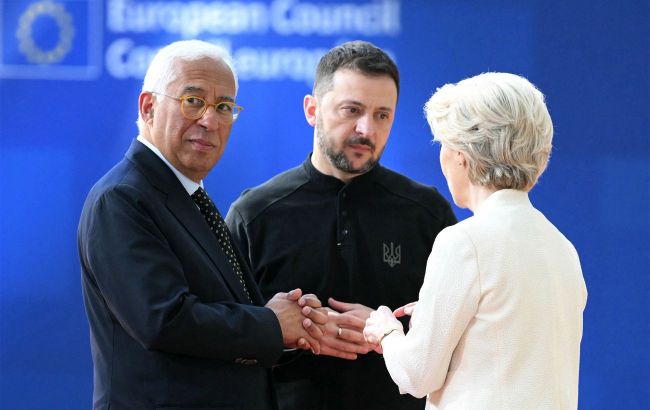 Photo: António Costa, Volodymyr Zelenskyy, and Ursula von der Leyen (Getty Images)
The European Union is looking for another 70 billion euros for Ukraine in 2027. Russia has intensified its strikes, so the previously agreed loan no longer covers Ukraine’s needs, and Brussels has no easy way to find the money, reports Euronews.
Last week, at the end of a two-day summit, EU leaders spoke with Ukrainian President Volodymyr Zelenskyy. He outlined the scale of the funding shortfall.
“The war will cost €155 billion next year. And we need at least €70 billion more from you: for defence, for weapons, and for our resilience. This is a realistic amount. And I ask you to find this support. It will help us hold Russia back,” Zelenskyy said.
According to him, the additional money will help Ukraine increase production of its own advanced drones. They are needed to stop Russia’s advance on the front lines, disrupt its supplies, and weaken its war machine.
EU leaders tasked the European Commission with finding ways to close this gap. It is significantly larger than Brussels had expected.
Why the old loan is not enough
Until now, the EU has relied on a 90 billion euro loan approved by EU leaders last December. It was supposed to cover two-thirds of Ukraine’s combined financial and military needs for 2026 and 2027. The rest was expected to come from other allies.
The European Commission had expected the war to end in 2026. Instead, Moscow has intensified its offensive, including daytime strikes intended to undermine Ukraine’s already weak economy.
Kyiv has been warning for weeks that it needs another $32.6 billion for its budget and $45 billion for its military next year. That amounts to $78 billion, or approximately 70 billion euros. Brussels initially declined to comment on this figure, but after several rounds of technical discussions, it accepted the estimate.
The 70 billion euros will be in addition to the 45 billion euros the EU plans to disburse under the existing loan and several billion euros from other programs.
Brussels stresses that this will be a “joint effort” with other allies, including the United Kingdom, Norway, Canada, and Japan.
“We always said that we cannot walk this alone. We cannot do this all alone. Therefore, our partners in general must step up. They have to come forward with pledges, and they have to deliver on those commitments. This is very important,” a European Commission spokesperson said.
It remains unclear what share of the 70 billion euros will come from the EU, as the previous “two-thirds to one-third” split has not worked. It is also unclear how quickly Kyiv needs the money. The only thing that is clear is that there are few options for raising such a sum quickly.
Additional pressure is coming from disputes over the EU’s next long-term budget and preparations for the presidential election in France. Front-runner Marine Le Pen has promised to end all aid to Ukraine.
What options does Brussels have?
New borrowing on financial markets. According to diplomats and officials, the most likely option is to raise joint debt on financial markets again, as the EU is already doing for the 90 billion euro loan. The European Commission could expand the existing lending mechanism and effectively extend the current arrangement.
The bloc has a stable AAA credit rating. Its bonds have been in demand since the COVID-19 pandemic, with demand at auctions often exceeding supply. Former Italian Prime Minister and European Central Bank President Mario Draghi has called for large-scale borrowing.
However, the financial situation has deteriorated sharply since December. Global borrowing costs have risen because of higher oil prices, growing government debt, and strong demand for money to fund artificial intelligence projects.
European countries have been hit hardest, particularly those that already have high levels of debt. Belgium now borrows at interest rates similar to Greece’s, while France pays more than Italy.
As a result, new borrowing is politically sensitive and difficult because it would increase interest payments. The yield on 10-year EU bonds rose from 2.8% in January to 3.44% in September. This is a noticeable increase, but it is smaller than in many other markets.
The European Commission said rising borrowing costs had affected the entire world and that the EU’s relative position had not deteriorated.
“We remain an extremely competitive issuer,” a European Commission spokesperson emphasized.
If joint borrowing becomes the main option, several countries are likely to opt out. Hungary, Slovakia, and the Czechia have already been exempted from the 90 billion euro loan. At last week’s summit, Slovak Prime Minister Robert Fico said that he and Hungarian Prime Minister Peter Magyar had agreed to maintain this policy.
“If they (other countries) want to provide a loan to Ukraine, they can do so, but at least two countries are indicating at this point that we will not participate in this financial mechanism. We show solidarity in other ways,” Fico said.
Bulgaria is also likely to stay out. Its new prime minister, Rumen Radev, has repeatedly criticized the EU’s military aid to Ukraine.
Frozen Russian assets. In recent weeks, several countries have again proposed another approach: using the frozen assets of Russia’s central bank. Within the EU, these assets are valued at 210 billion euros.
Sweden, the Netherlands, Spain, and Poland revived the discussion in August. Northern European countries, the Baltic states, Germany, and Ireland subsequently expressed their support.
These are the same countries that pushed hardest last year for an interest-free loan to Ukraine backed by these assets. Most are among Ukraine’s largest bilateral donors and view the assets as a way to distribute the burden fairly.
The proposal failed because of opposition from Belgium. Euroclear, the securities depository in central Brussels, holds 185 billion euros of these assets.
Belgian Prime Minister Bart De Wever warned that using the assets would amount to confiscation, with catastrophic consequences for the country. He demanded full collective risk-sharing and unlimited guarantees against all possible liabilities.
Leaders feared having to bail out Belgium’s banking system and opted for joint borrowing for the 90 billion euro loan at the last minute.
Despite this, supporters of the idea have not abandoned it. Ukraine continues to raise the issue. According to Zelenskyy, if Europe does not use the assets, Russia will try to get them back.
According to unofficial information, the US proposed partially unfreezing the assets to push Russia toward peace negotiations. Europeans rejected the plan.
“The main priority is that Russia doesn't have the opportunity to influence later on the discussion on these assets, because we know very clearly they want to bring these assets back. It's one of Russia's aims,” Zelenskyy said last week.
De Wever remains categorically opposed. At the summit, the Belgian prime minister took the floor on his own initiative and told his colleagues that his objections had not changed, Euronews reports. He believes the money should remain frozen until the end of the war to prevent interference from Moscow or Washington.
Officials and diplomats left the summit with the feeling that the assets had little chance of being used this time. The failure of last year’s proposal is still fresh in their minds. France and Italy, whose support would be decisive, are still considered hesitant about the idea.
Belgium’s position is even tougher. It opposes not only using the funds but also transferring them from Euroclear to a repository owned by the EU. Some have proposed this legal workaround as a way to break the deadlock.
“The issue will be coming up over and over. Eventually it may find a resolution. I don't think short-term it's going to be on the agenda, like this month or the next one,” EU Ambassador to Ukraine Katarína Mathernová told Euronews.
Ukraine has become the world’s second-largest IMF debtor. As of the end of September 2026, it owed the Fund $14.5 billion, while Argentina remains the largest debtor, with $56.9 billion.
Slovakia and Hungary refused to finance the EU’s new loan to Ukraine for 2027. Fico also called it dangerous to link negotiations on the EU budget for 2028–2034 with funding for Ukraine.