2,000-year-old Vesuvius scrolls decoded: AI sees text through the ash

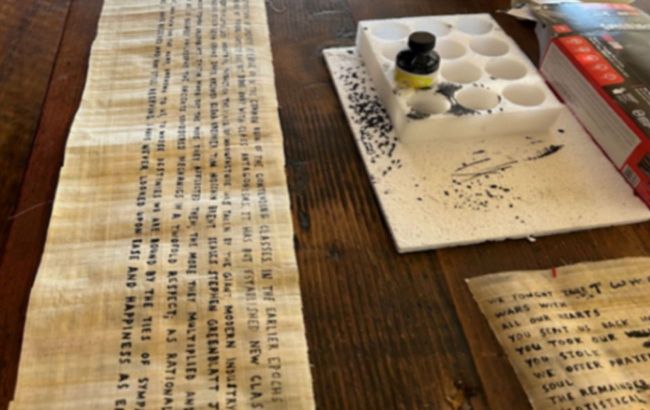 New technology will allow scientists to read more than 600 scrolls (photo: Seiler et al., 2026, PLoS ONE/CC0)
AI will be able to more quickly identify which of the carbonized Herculaneum scrolls can be deciphered. Scientists have developed a method for detecting scrolls written with lead-based ink — the ones best suited for algorithmic analysis, according to a study published in the scientific journal PLOS.
Why were the ancient scrolls considered lost?
During the catastrophic eruption of Mount Vesuvius in 79 AD, not only Pompeii but also the city of Herculaneum was destroyed.
In a luxurious villa that may have belonged to Julius Caesar’s father-in-law or the philosopher Philodemus, archaeologists discovered the only surviving library from the ancient world. It contains more than 600 charred papyrus scrolls.
Hot volcanic gases instantly charred the papyri and turned them into fragile carbon. Physically unrolling the scrolls is impossible because they would crumble into ash at the slightest touch.
To decipher the text, scientists created the Vesuvius Challenge project, which uses micro-computed tomography and artificial intelligence for so-called “virtual unrolling.”
However, researchers faced a major obstacle: most ancient Roman inks were made from soot and water.
Since both the papyrus and the ink are made of carbon, X-rays can barely distinguish between them because of the extremely low contrast.
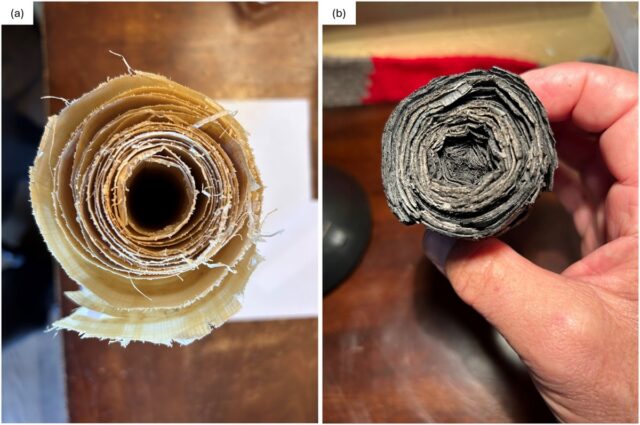
Papyrus scroll before carbonization (a) and after carbonization (b) (source: Seiler et al., 2026, PLoS ONE/CC0)
Experiment in the oven: How did scientists make the ancient text light up?
Inventor Douglas Seiler, together with a team of chemists and physicists, suggested that some of the scrolls may have been written with ink containing metals, particularly lead.
It is the presence of lead that allows X-rays to instantly detect the letters.
To test their hypothesis, the scientists conducted a large-scale experiment:
-
they purchased modern Egyptian papyrus made using ancient techniques and traditional ink;
-
they added lead nitrate to the ink in different proportions;
-
high school students used reed pens to write texts from various sources on the papyrus;
-
the scroll models were baked in an oven at extremely high temperatures without oxygen, fully recreating the carbonization process caused by the eruption of Mount Vesuvius.
The resulting carbonized scrolls were scanned using 3D X-ray equipment at the U.S. National Institute of Standards and Technology.
Letters written with lead-based ink stood out clearly in the scans, while adaptive software instantly unrolled the virtual scrolls and read the inscriptions.
How will this speed up the deciphering of ancient texts?
Thanks to this discovery, archaeologists will no longer have to spend months using complex equipment and trying to identify the silhouettes of carbonized words in the dark.
To screen the scrolls, it is enough to use a compact portable X-ray fluorescence scanner. It can instantly determine whether a particular scroll contains lead.
Papyrus scrolls written with lead-based ink will become the top candidates for scanning.
This will significantly speed up the work of the Vesuvius Challenge project and could allow scientists to read dozens of previously inaccessible philosophical, historical, and literary works from antiquity in the near future.