Ukraine could face double blow from Trump and France's far right: Former Ukrainian envoy, Oleh Shamshur

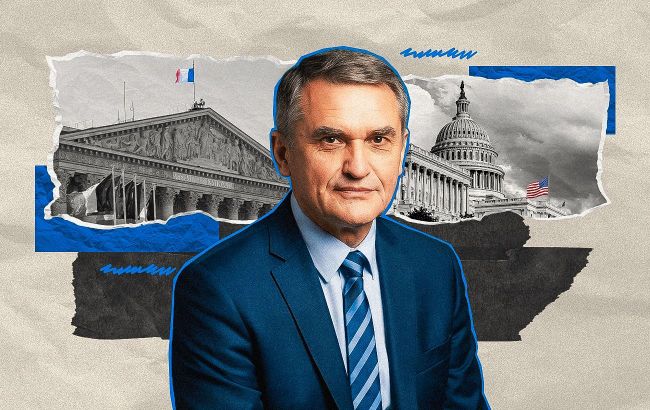 Oleh Shamshur (RBC-Ukraine collage)
A likely Democratic victory in the US elections will not change America's foreign policy toward Ukraine. However, the upcoming elections in France could see Marine Le Pen win power, potentially blocking aid to Ukraine.
Why Trump's impeachment is impossible and why Kyiv should already be reaching out to France's far right is what Oleh Shamshur, Ukraine's former ambassador to the United States (2005–2010) and France (2014–2020), discussed in an exclusive interview with RBC-Ukraine.
Key points:
-
US midterm elections: A Democratic victory in the House of Representatives is highly likely, but major changes in foreign policy or support for Ukraine should not be expected.
-
Trump's "imperial" approach: Even if Congress allocates funds or passes sanctions, Trump will sabotage those decisions. The threat of impeachment is merely a "political spectacle."
-
A bleak outlook through 2029: The next two years in relations with Washington will be extremely difficult, and positive changes should not be expected until at least the next US.= presidential term.
-
France's crisis and the Le Pen risk: Unrest and protests in France are strengthening the far right. Analysts broadly agree that Marine Le Pen will make it to the second round of the presidential election.
-
Threats to Ukraine from the far right: If Le Pen comes to power, she has pledged to end financial aid to Kyiv, block support at the EU level, and ban the supply of long-range weapons.
-
Ukraine's diplomatic task: Kyiv needs to carefully establish contacts with Le Pen's inner circle now to minimize potential losses if she wins.
The political situation in the United States ahead of the midterm elections and France's deepening crisis are creating new challenges for global security and support for Ukraine. What will change in Washington if Democrats win control of Congress? Why is America's two-party system gradually approaching a crisis? And, most importantly, what would Marine Le Pen's possible rise to power in France mean for European and Ukrainian support?
United States: Midterm elections, Trump as the "director of the universe," and prospects for Ukraine
– Let's start with the United States. Pollsters predict a high probability that Democrats will take control of the House of Representatives and have a decent chance of winning the Senate. How much would that change the balance of power? Should we expect major changes after November 3?
– Unfortunately, there will be no dramatic changes. The current picture suggests that Democrats could win the House of Representatives, and by a relatively comfortable margin rather than by a razor-thin majority. Forecasts for the Senate are more cautious, but that scenario is also possible.
If Democrats take the House, it will mean the end of Donald Trump's attempts to push through his legislative agenda. Democrats will start making his life miserable: launching investigations and holding hearings. Trump understands this perfectly well, which is why he is doing everything he can to limit the Democrats' gains.
– You mentioned the possibility of impeachment. If Democrats take both chambers, is that a realistic scenario?
– Absolutely not. That's in the realm of nightmares. A simple majority in the House of Representatives is enough, but impeachment requires a two-thirds vote in the Senate, which Democrats will not have under any circumstances. So it would be nothing more than a political spectacle, and Democrats are unlikely to want to waste political capital on it, as they did ahead of the 2024 elections.
– How would a Democratic victory in Congress affect US foreign policy and aid to Ukraine?
– The president remains the main figure shaping foreign policy. We will not see radical changes in foreign policy. Domestic policy will depend on whether Trump is willing to take reality into account. One theory is that he will become even more aggressive, trying to prove to everyone that he is the "director of the universe" and of the United States, and that Congress cannot tell him what to do.
As for aid to Ukraine or sanctions, even if Congress allocates funds or passes a sanctions bill, Trump operates according to his concept of "imperial presidency" and believes he has the right to decide whether or not to use that money. We have already seen him sabotage or delay the implementation of decisions under the pretext of "peace negotiations" with Russia.
– So there is little reason for optimism for now?
– Overall, we should prepare for the fact that we are unlikely to see any meaningful changes before January 2029 – unless, of course, someone with the same political outlook as Trump comes to power after him. The next two years will be extremely difficult for us.
– What is happening within the Democratic Party? Who could become its leading candidate in the presidential election in two years?
– There is no clear frontrunner right now. It is more of a "mixed bag" of candidates. Among the prominent figures is a group of strong governors from various states, such as California Governor Gavin Newsom. Could Kamala Harris make a comeback? Her nomination cannot be ruled out, but I am very critical of her as a politician. She clearly failed to make her mark. We should also pay attention to new faces, such as Georgia Senator Jon Ossoff, who is a very skilled communicator.
The growing strength of the party's far-left wing – Alexandria Ocasio-Cortez and Bernie Sanders – is another source of concern. If this faction becomes large in Congress, its members could push the argument that the focus should be on ordinary Americans rather than aid to Ukraine. This would make the situation even more difficult for us. Overall, these developments in both parties point to a systemic crisis in America's two-party system, which could eventually lead to the emergence of a third political force.
France: The far right is gaining ground, a choice between "bad and worse," and risks for Ukraine
– Let's turn to Europe. Many experts describe the riots and protests in France as a direct path to a Marine Le Pen presidency. How well-founded are these concerns?
– The fact that Le Pen will make it to the second round of the presidential election is already a consensus view in France. The latest unrest, particularly involving radical left-wing forces led by Jean-Luc Mélenchon, has further boosted Le Pen's ratings.
If the second round comes down to Le Pen versus Mélenchon, it will be a choice between bad and even worse for both France and us. For Ukraine's interests, the radical left is no less – and perhaps even more – dangerous. Our only hope is that centrists and traditional conservatives will unite behind a single strong candidate, such as former Prime Minister Édouard Philippe, and that the "anyone but the radicals" formula will work.
– If Marine Le Pen does become president of France, what should Ukraine expect?
– There will certainly be no positive changes. Most importantly, she has clearly stated that she will end bilateral financial support for Ukraine. This position is rooted in the truly disastrous state of France's public finances.
But there is something even worse: she has pledged to block aid to Ukraine at the EU level through her representatives in the European Parliament, led by Jordan Bardella. She supports ending the war at any cost, opposes providing long-range systems and lethal weapons, and would allow only non-lethal aid and training. Incidentally, this is very close to Trump's position.
It is also worth remembering that Le Pen's party was deeply pro-Russian – or, more precisely, pro-Putin – for a long time. People with those views have not disappeared from her inner circle. She also opposes Ukraine joining the European Union.
– Does this mean Ukraine should start building diplomatic bridges with her team now?
– Absolutely. We need to start talking to them now to establish clearly what is possible and what is not, and to be ready to minimize the damage if she wins. However, this must be done very carefully to avoid damaging relations with our current allies and Le Pen's political opponents.
– Could Le Pen's rise to power threaten the European project itself?
– Without a doubt. Although she has already abandoned her 2017 ideas of radically withdrawing from the EU or the eurozone and now talks about "reforming from within," her rise to power would inevitably strengthen the position of Euroskeptics, weaken the EU as a whole, and undermine the Franco-German partnership on which the European Union rests. This would be a huge problem for both Europe and Ukraine.