Trump won't force Ukraine into a bad peace deal, US expert says


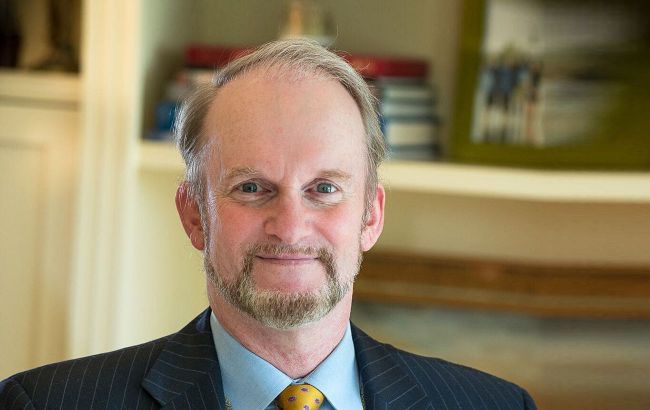 Photo: Gregory Slayton (kspa.com.ua)
Future US congressional elections and Trump's business approach to military aid are once again making Kyiv worry about the stability of support from Washington. Especially against the backdrop of the US president's constantly contradictory statements and the activity of the pro-Kremlin lobby in America.
RBC-Ukraine discussed with American diplomat and entrepreneur Gregory Slayton why Trump will not be able to impose an unfavorable peace on Ukraine and how Russian propaganda works in the US.
Key points:
- US support. Most Americans do not support Trump's transactional approach to aid and view Ukraine as a democracy.
- Relations with Russia. Trump's accommodating approach toward Putin is an unproductive policy that caters to the former president's circle.
- Congressional elections. Because of his low approval ratings, Trump is seeking victories, but the system of checks and balances will not allow him to force Ukraine into peace.
- What matters for the ambassador to the US. Ukraine's new ambassador to the US, whoever takes the position, should be active in the media (CNN, Fox News) to counter Russian disinformation.
Gregory Slayton is a person who sees American politics through two lenses at once: diplomatic and business. At one point, he headed the US diplomatic mission in Bermuda after being appointed by George W. Bush, becoming the only Republican diplomat whose tenure was extended twice by the Democratic administration of Barack Obama.
At the same time, his background as a venture investor in Silicon Valley allows him to understand the logic of Donald Trump, who operates in terms of pragmatism, deals, and risks.
In a conversation with RBC-Ukraine, which took place on the sidelines of this year's National Prayer Breakfast, he considers whether the mercantile policy of the White House is truly effective and why being accommodating toward the Kremlin brings Washington more problems than benefits.
— You visited Ukraine when Russia escalated its attacks. In July, we saw the highest number of civil casualties in Ukraine. What does this reality mean for you personally?
— Well, thank you very much for this question. First of all, to speak about... targeted people... In fact, I'm married to a woman whose father is Ukrainian. So, my family is Ukrainian, in a way of speaking.
The horrible attacks by Russians continue, and I'm glad to see Ukrainians fighting back, fighting for freedom, for their independence, for their families, and for their future. And that's why I can tell you that the American people - and I am American - are not going to abandon Ukraine. It's not going to happen.
— Under the Trump administration, we saw the shift towards the transactional approach, when weapons were only for money. Is this approach shared among American society, especially the conservative part, and in the establishment?
— Certainly it's not shared by American society in general. There may be a small sliver of the population who think Donald Trump is the second coming of Jesus Christ, which he is not, right? And maybe they think it's good. But no, the American president should not be transactional. He should be working in the interests of all Americans and all people of good faith in this world. Now, I'm a Republican, don't get me wrong. I'm a conservative Republican, but no, transactional politics is... it just doesn't work.
— For Ukraine, the top priority is Patriot interceptors. And Trump first announced that he would give the license for manufacturing these interceptors in Ukraine, and then recalled his announcement. In your opinion, why did it happen?
— Well, that's complicated, of course. Trump ran into Iran, he thought that he was going to win very quickly in Iran. That didn't happen. And now we're short on Patriot interceptors because Trump just... just didn't plan properly. That's a very difficult situation. We should never be in this situation, but we are. And I'm very apologetic to our partners in Ukraine and other partners around the world, because Patriot interceptors are critical not just here, but other places - Israel and other places as well - and we just don't have enough.
— The Trump administration is very reluctant to put pressure on Russia, especially with sanctions. What are the reasons for such policy?
— You know, the truth is no one knows. No one knows why Trump is... He wants to appear so tough with someone like our Canadian partners. They've been partners forever. And now all of a sudden he's beating them up. But he seems to be always gentle and cuddly with Vladimir Putin. Now, why is that? There are a lot of rumors about that. I don't know, but I think it's completely unproductive. Completely unproductive.
— What could change this position and make Trump take more pressure on Russia?
— Well, hopefully Trump sees, one, that Ukraine is winning the war, which finally I think he's understanding that Ukraine's really beginning to win. Not total, because of course Russia — much bigger army, much bigger country. But Ukraine has done incredibly well.
And I think people... do you know who Laura Loomer is? Right, so Laura Loomer was a big Putin apologist. She was huge for Putin. Now she's totally changed, and she said she was fooled by pro-Kremlin propaganda. Well, that's true, she was. Tucker Carlson, many others, right?
But more and more of those people are coming to see that what they believed before was just propaganda, it wasn't true. And Trump, you know, like everybody else, he is influenced by the people around him. So, I'm hoping that more and more people will speak the truth to him about the fact that Ukraine is a loyal and faithful partner, and a partner we need to protect.
— In November there will be congressional elections. And some analysts say that Trump needs a success story to demonstrate to the voters that he is a powerful leader. And one of these stories could be a peace deal or at least a ceasefire on terms that are unfavorable to Ukraine. What do you think about these ideas?
— Well, certainly Trump wants to have some victories. I mean, he's way down in the polls. And, you know, inflation is bad, foreign policy has been a disaster. He is just... he continues to make enemies where he didn't need to, but that just seems to be his way. And that's a big problem.
So, yes, of course, like any president before an election, he's looking for some kind of victory. What I'm thankful for as an American is that, you know, we're a democracy. Trump cannot force Ukraine to make (an unfavorable) peace. Trump cannot even force the United States to make peace, right? I mean, he can't force us, force the country, to force Ukraine. So, there's a division of powers in the United States, and that's a very, very good thing.
— And the last question. In Ukraine, there is a vacant post of Ukrainian ambassador in Washington. Regardless of who will be appointed, what should be the three priorities for him from your experience?
— Yes. Well, I've known your last... the last few ambassadors personally. And I think you've had good ambassadors, but what I'd like to see is a more media-savvy ambassador. Someone who can go on CNN and Fox and do really well, and convince people, beat back that Russian garbage, right? Because in the absence of truth, lies win. Do you understand what I mean? In the absence of truth, lies win. So Russia's lying, lying, lying, lying, lying, and no one is opposing that. The Ukrainian ambassador to the United States needs to get on the biggest media channels there are and tell the Ukraine story. That's very important.