Secret Moscow trip: Why CIA director Ratcliffe traveled to Russia


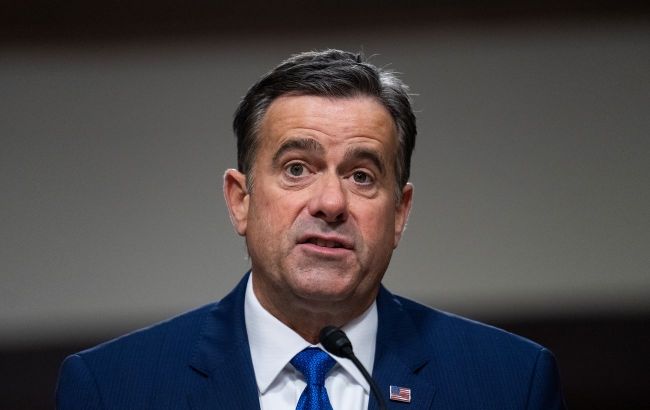 Photo: John Ratcliffe, Director of the CIA (Getty Images)
The main possible version of the secret visit of CIA Director John Ratcliffe to Moscow may be a warning to Russia about the consequences of a possible escalation of the war, political analyst Volodymyr Fesenko told RBC-Ukraine.
Why Ratcliffe went to Moscow instead of Witkoff
When asked why Ratcliffe, rather than US presidential special envoy Steve Witkoff, went to Moscow this time and what the purpose of his visit might have been, Fesenko noted that the version about negotiations is only one of the possibilities.
He considers the most convincing version to be the delivery of certain signals and warnings to the Kremlin.
"It is quite likely, and I also lean toward this, that the main topic was certain warnings about the risks of escalation of the war and possible scenarios for escalation of the war by Russia," Fesenko said.
The expert recalled that Ratcliffe's predecessor, William Burns, made a similar visit in November 2021. At the time, the CIA chief also secretly traveled to Moscow to warn Putin against invading Ukraine. Later, Burns also met with Russian Foreign Intelligence Service chief Sergey Naryshkin in Türkiye in late 2022 to convey details about the unacceptability of using tactical nuclear weapons.
Iran and an assassination attempt on Trump
Fesenko also did not rule out that the Middle East could have been among the topics discussed. According to him, this is related to the current state of negotiations on ending hostilities between Iran and the United States.
"Given the current state of negotiations on ending hostilities between Iran and the United States, plus the fact that Russia, one way or another, together with China, is Iran's most significant resource partner and may potentially act as a mediator, at least in resolving some problems, this is quite likely," he said.
The political analyst suggested that through Moscow, the CIA director may have conveyed signals that any attempts to assassinate US President Donald Trump will end fatally.
"Judging by the information on how Trump returned from the NATO summit in Ankara, it is quite likely that Iranian intelligence services may be preparing such an assassination attempt. And the Americans are trying to act preemptively here and send such, I would say, stern warnings. So this is also one of the likely versions," Fesenko said.
Mobilization in Russia and the risk of an attack on NATO
The Wall Street Journal claims that the reason for Ratcliffe's visit was intelligence about preparations for a mass mobilization in Russia and possible provocations against countries on NATO's eastern flank. Fesenko calls this version the most convincing.
"It is not just about mobilization. Mobilization itself is not something that worries the White House. I think they view it with restraint. But the risks, the risks of escalation of the war. Mobilization is a prerequisite, one of the important prerequisites for escalation," the analyst emphasized.
According to him, mobilization could be used to increase the capabilities of Russian forces in the Donbas and, more broadly, for the war against Ukraine.
"But it is also quite possible that this could be used to free up some of Russia's reserves or combat-ready military units to attack, for example, the Baltic countries. Or there could be a test in such a hybrid mode, but really to break the balance of power," the political analyst said.
Russia could use mobilization resources to launch an attack or a hybrid provocation against the Baltic states, Poland, or Finland to break this balance and force the West to raise the stakes or abandon its support for Ukraine, the political analyst explained.
"This could worry the Americans. They will not take a large-scale, active part in the hostilities, but for them this is a potential second front, a potential problem, and therefore I think they could warn the Kremlin not to do such stupid things," Fesenko said.
Why Ratcliffe's visit was secret
Speaking about the secret nature of the visit, Fesenko explained that the status of the CIA director and contacts at this level usually imply confidentiality.
"The status of the CIA director, his contacts of this kind, are generally classified information. He is not an official negotiator, and, as a rule, intelligence chiefs work quietly and do not attract a great deal of media, political, or other attention," he said.
On August 25, a US Air Force military transport aircraft landed at Moscow's Vnukovo airport, while an American diplomatic convoy sped through the streets of the Russian capital accompanied by police.
It later became known that CIA Director John Ratcliffe had arrived in Russia on an unannounced visit. The trip coincided with the emergence of secret decrees from Vladimir Putin and Washington's request that Kyiv temporarily refrain from strikes on Moscow and St. Petersburg.
The US has officially declined to comment on the purpose of Ratcliffe's visit to Moscow. The Kremlin, meanwhile, claims that he did not meet with Putin and that the purpose of the CIA chief's visit was the "establishment of contacts between security services."